


Whisky Journey 2026 returns to Singapore for its fifth edition on 27 and 28 November 2026, bringing more than 300 whiskies to the Marina Bay Sands Expo & Convention Centre.
While Scotland and Ireland remain firmly represented, this year’s Singapore whisky festival is looking increasingly international. Alongside familiar names, visitors can expect whiskies from the United States, China, Australia and some of the less obvious corners of the British Isles.
It makes Whisky Journey less of a conventional tasting fair and more of a snapshot of how quickly the global whisky landscape is changing.
For anyone whose whisky experience begins and ends with a bottle of Scotch at home, this could be an interesting opportunity to venture beyond the usual suspects.

American Whiskey Takes the Spotlight
One of the more prominent themes at Whisky Journey 2026 is American whiskey. Bourbon has become considerably more visible in Singapore over the past few years, but there remains a surprisingly large world beyond the bottles most commonly seen behind cocktail bars.
Whisky Journey will feature Eagle Rare, the Kentucky straight bourbon aged for at least a decade, alongside Weller, known for using wheat rather than rye as its secondary grain. Sazerac Rye offers another contrast altogether, with the drier, peppery character that gives rye whiskey its distinctive personality.
Tasting them side by side is arguably more useful than reading pages of tasting notes.
The differences tell a broader story about how whisky evolved after Scottish and Irish immigrants brought their distilling traditions to America. Local agriculture eventually shaped the spirit, with rye becoming prominent around Pennsylvania and Maryland, while corn increasingly influenced whiskey further south and west.
The result is that American whiskey today can range from soft and caramel-rich to intensely spicy, depending on what goes into the mash.
The Rise of Chinese Whisky
Chinese whisky is still unfamiliar territory for many drinkers in Singapore, yet significant investment is being made in distilleries across the country, often combining international distilling expertise with distinctly local ingredients and environments.
Two producers appearing at Whisky Journey 2026 illustrate how different those approaches can be.
Chun’an Malt Whisky Distillery sits near Qiandao Lake and is backed by Scottish whisky producer Angus Dundee Distillers. Its whisky is matured partly within natural mountain caves, introducing a dramatically different ageing environment from the warehouses traditionally associated with Scotland.
The Chuan Malt Whisky Distillery offers another interpretation.
Located near Mount Emei in Sichuan and led by Master Distiller Dr Yang Tao, the distillery works with familiar bourbon and Spanish sherry casks while incorporating Chinese oak into its maturation programme.
It raises an interesting question for whisky drinkers: if terroir matters in wine, how much should geography matter in whisky?
For years, whisky’s identity has been closely associated with Scotland’s islands, valleys and rivers. China’s growing distilling scene may eventually add a completely new set of places to that mental map.
Why Tasmania Is Emerging as a Whisky Destination
Australia enters the Whisky Journey 2026 line-up through LARK Whisky, one of the pioneers of Tasmania’s modern whisky industry.
Tasmania sounds like an unlikely whisky destination until you consider its climate. Warm summers, cold winters and pronounced seasonal fluctuations can accelerate the interaction between spirit and barrel. Distillers frequently describe this as particularly active maturation, producing whiskies with substantial flavour despite comparatively small-scale production.
LARK has been making whisky since the early 1990s and helped establish Tasmania as a serious spirits region rather than simply a source of wine, produce and wilderness holidays.
For Singapore whisky drinkers accustomed to more traditional whisky-producing regions, Australian whisky offers another perspective on how climate and geography can influence the spirit.
Scottish Whisky Beyond the Usual Names
Of course, Scotland remains very much part of the story. This year, however, some of the more interesting Scottish names come from places and producers that may not immediately spring to mind.
Lerwick Distillery is developing single malt whisky in the Shetland Islands, while the Isle of Harris Distillery draws heavily on the landscape and maritime culture of the Outer Hebrides.
Ardnahoe brings another relatively young Islay distillery into the mix, with a style that balances peat smoke with fruit rather than pursuing smoke for its own sake.
Then there is Woven, an Edinburgh-based whisky maker taking a contemporary approach to blending.
Blended whisky has historically suffered from an image problem among enthusiasts who instinctively gravitate towards single malt. Woven approaches blend more like a culinary composition, combining whiskies deliberately to create flavours that would be difficult to achieve from a single distillery.
It is a useful reminder that the words “single malt” are not automatically synonymous with better whisky.
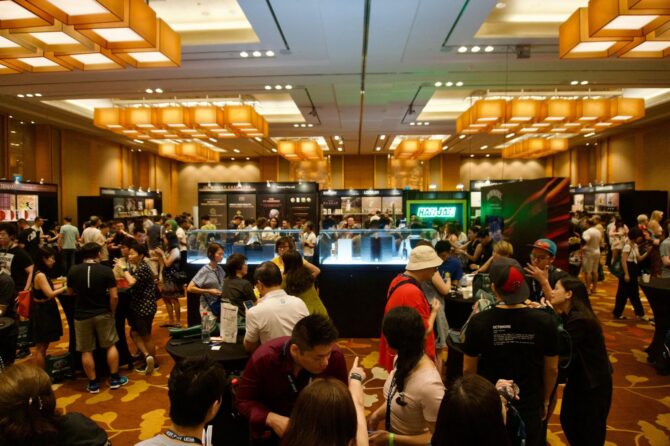
What Makes a Whisky Festival Worth Visiting?
The challenge with large whisky tasting events is knowing where to begin.
Trying everything is neither realistic nor advisable. A much better strategy is to treat the event like a restaurant tasting menu.
Choose a theme.
You might compare American bourbon and rye. You could spend an hour exploring Chinese whisky. Alternatively, taste several whiskies from islands and coastal regions to see whether you can actually detect the maritime qualities frequently described in tasting notes.
Speaking to the distillers and producers is often more rewarding than simply moving from booth to booth.
Ask what they drink themselves. Ask which bottle they believe is overlooked. Ask what they would recommend to someone who normally drinks an entirely different style.
Those conversations are often where the memorable discoveries happen.
There are practical reasons to wander slowly, too. Complimentary tastings are available at participating booths with the relevant passes, while additional pours start from S$2. Selected rarer and older whiskies will also be offered by the dram, with some starting from S$6.
That opens the possibility of trying bottles most people would hesitate to purchase without knowing whether they actually enjoy them.

A Good Place to Start Christmas Shopping
Whisky Journey 2026 falls almost exactly a month before Christmas, turning the event into something of a reconnaissance mission for festive gifts.
There will be event-exclusive bottlings, bundles and bottle promotions, alongside rarer expressions for collectors.
The safest gift, however, may still be the bottle you tasted and genuinely enjoyed rather than the one with the most impressive age statement.
Whisky Journey 2026 Tickets, Dates and Venue
Whisky Journey 2026 takes place on Friday, 27 November from 1pm to 11pm and Saturday, 28 November from 12pm to 10pm at the Level 3 Hibiscus Ballroom, Marina Bay Sands Expo & Convention Centre.
Early-bird Standard Passes are priced at S$48 and include two-day admission, a Whisky Journey Passport, a Glencairn glass, a lanyard and one complimentary tasting at participating booths.
The S$12 Explorer Pass also provides two-day admission, a Glencairn glass, and a lanyard, although complimentary tastings are not included.
With more than 300 whiskies expected, there is little reason to approach the weekend as a mission to taste everything. Find a few unfamiliar countries, pick a few bottles you have never seen before, and see where the journey takes you.
Click here to discover more delicious food options in Singapore.